This 2026 edition, following previous stops in Dakar, Dar es Salaam, and Niamey, broadens its scope from seed sovereignty to genetic sovereignty, addressing in particular the rights over agricultural data, the pressures of commercial frameworks on local crop varieties, and the governance of farmer-managed seed systems.
Indeed, the digital transition has now penetrated to the very heart of African food systems. The collection, storage, and analysis of genetic data linked to seeds (biodigitalisation) opens unprecedented scientific possibilities. Yet it simultaneously raises fundamental questions about who holds control over this living heritage.
The slides projected during the conference made an unambiguous point: farmer seed systems are potentially threatened by this relentless digitalisation, unless it is guided by robust and equitable governance mechanisms.
The presentation identifies five major risks under the question: "Implications for Farmers' Seed Systems: What Is at Stake?"
- Reduced farmer autonomy: when seed data is captured by external actors, farmers progressively lose control over their own genetic resources.
- Commercialisation of biodiversity: local varieties freely exchanged across generations can be patented or monetised by private companies through their digitalisation.
- Increased dependency: digitalisation can deepen farmers' reliance on technology platforms, improved seed suppliers, or external certification systems.
- Marginalisation of local innovation: peasant knowledge, shaped over centuries of observation and adaptation, risks being rendered invisible in the face of laboratory-generated data.
- Erosion of seed sovereignty: at the end of this chain lies the most fundamental threat the communities' basic right to decide over their own seeds.
Under the heading "Biodigitization and Indigenous Knowledge – Critical Governance Questions", the presentation poses five questions as simple as they are decisive:
Who owns the knowledge? Who controls access? Who grants consent? Who receives the benefits? Who determines appropriate use?
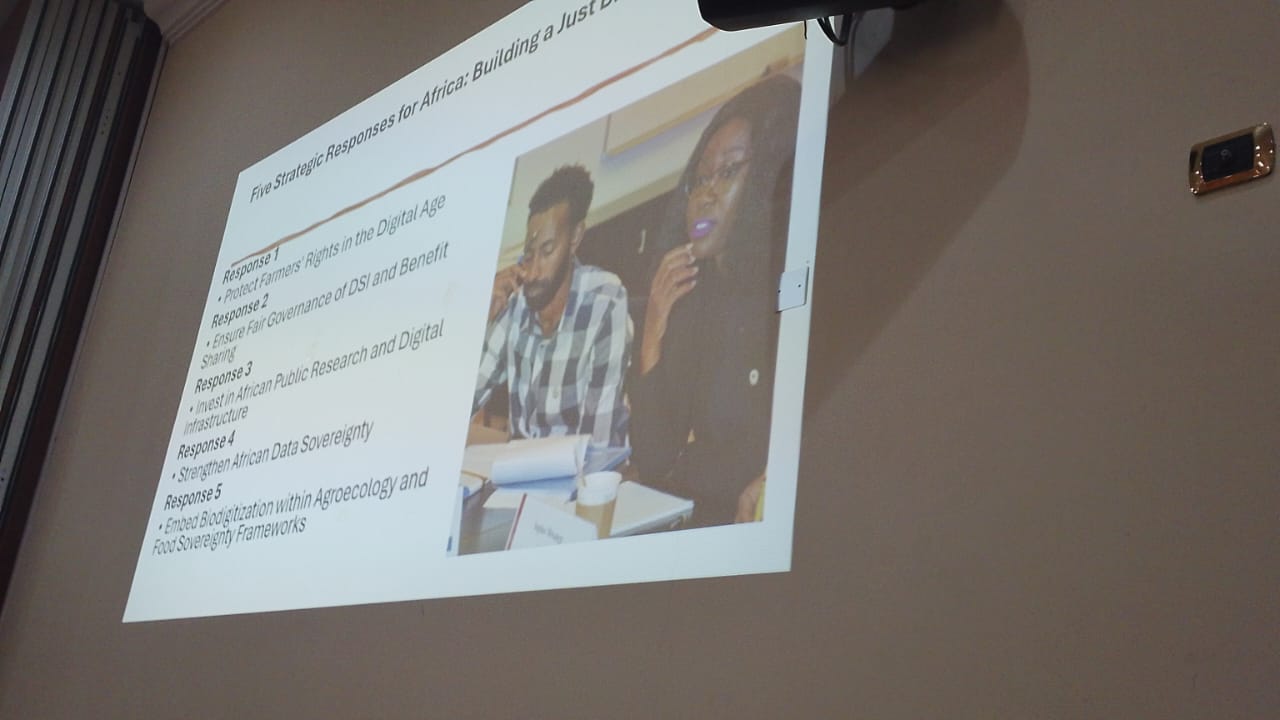
Confronted with these threats, the presentation puts forward an agenda built around five strategic responses, framed by a clear vision: "Building a Just Biodigital Future."
- Protect farmers' rights in the digital age: ensure that digitalisation does not erase the established rights over farmer-developed varieties.
- Ensure fair governance of Digital Sequence Information (DSI) and benefit-sharing: in line with the ongoing debates under the Nagoya Protocol and the Convention on Biological Diversity.
- Invest in African public research and digital infrastructure: so that Africa is not merely a producer of raw data, but a full actor in its analysis and valorisation.
- Strengthen African data sovereignty: by developing legal and technical frameworks that enable states and communities to retain control over their agricultural genetic data.
- Embed biodigitalisation within agroecology and food sovereignty frameworks: so that digital tools serve agroecological transitions rather than undermine them.
Participants nonetheless acknowledged that digitalisation is already well advanced and can, in fact, be a powerful tool for documenting, preserving, and enhancing Africa's agricultural biodiversity.
However, without governance that is both robust and centred on community rights, it risks becoming yet another vehicle for the appropriation of the continent's natural resources.